
Comprehensive Bike Insurance: What It Covers Beyond Third-Party Liability

6 Views
The rider crashes his bike into a pothole on a rainy night. In the process, he falls off balance and collides with a parked vehicle. This requires compensation from the car owner, which is taken care of under the third-party insurance scheme. However, the rider’s own damaged bike is not part of the third-party deal.
This gap is why comprehensive bike insurance deserves a closer look. Third-party liability is the legal minimum, since the Motor Vehicles Act requires it for vehicles used on public roads. Anything beyond that is a choice, and a choice worth making with open eyes.
What Is Comprehensive Bike Insurance?
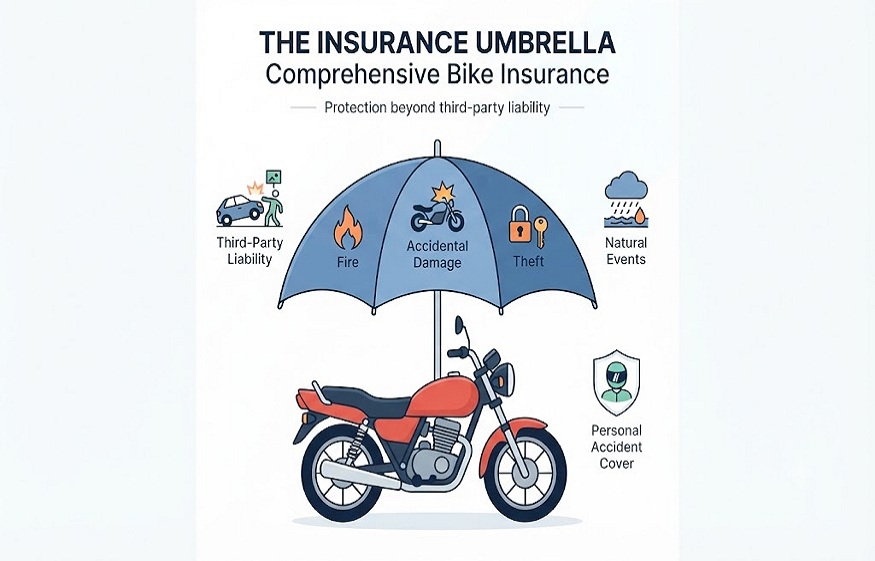
The comprehensive insurance plan, usually offered as a bundled insurance plan, consists of two tiers. One of those is the tier of third-party liability – your personal liability for causing harm, death or loss to others by accident. The other is own damage cover, which covers any damage that might be done to your motorcycle by the named perils.
Comprehensive insurance is not legally required but third-party insurance is. The choice to have comprehensive insurance depends on how much risk do you want to transfer to the insurance company and how much would you like to retain.
What Does It Generally Cover?
Sections for own-damage usually cater for accidental damage, loss through theft, loss through fire, explosions, as well as natural disasters like floods, earthquakes, and storm. Third-party liability coexists with all this.
The word “commonly” works hard in the sentence above. Policy language varies from one insurer to another. Different circumstances, like water getting into the engine after traveling in a flooded road, may be handled differently by different insurance companies. What is paid or what is not paid is dictated by policy language.
Personal Accident Cover in Bike Insurance
Damage to your motorcycle and injury to you are different financial problems, and they are insured differently. Where the owner-driver suffers accidental death or disability, personal accident cover in bike insurance provides a benefit, subject to the policy’s terms. However, a mandatory personal accident cover for owner-drivers is available in Indian motor insurance, although details such as eligibility and sum insured depend on the prevailing regulations and your insurance policy. In case you have an independent personal accident or term insurance policy, then you should be aware of the interaction between the two policies.
Evaluate this component on its own. A strong own-damage section tells you nothing about what happens if the rider is hurt.
What May Not Be Covered
However, there are a number of exclusions common to most insurers and policies including normal wear and tear, breakdown that is purely mechanical or electrical in nature, intentional damages, and losses that occur because the cyclist lacks a valid license or is driving while intoxicated. Other exclusions include using the bicycle in a manner not permitted by the policy.
All of these are fairly normal. Insurances provide protection against unexpected losses. Having an insurance does not automatically mean a claim will be made successfully.
How to Evaluate a Bike Insurance Quote
A bike insurance quote that looks cheapest is rarely the cheapest outcome. Premium is what you pay with certainty, while the value of the cover only shows up when you claim. So, look at what sits behind the number.
Consider the Insured Declared Value (IDV) for your bike. The higher the IDV, the more expensive the premium will be, while the lower the IDV, the cheaper the premium will be; however, this means that the amount one will get from the insurer will also be smaller in case of theft or a total loss of the bike. Consider the deduction and add-ons available. Consider the terms for making a claim, the list of garages and the No Claim Bonus scheme.
Checking these bike insurance details before paying takes twenty minutes and can change the decision.
Where to Turn If Something Goes Wrong
Regulation of the insurance sector and consumer protection norms are governed by IRDAI. The General Insurance Council is an association of non-life insurance companies. In case the insurance company does not process or reject the claim, one should start with its grievance redressal mechanism. If this doesn’t help, there is an alternative provided by Insurance Ombudsman.
The Practical Takeaway
Insurance is a form of risk management, not a form of investment. What one needs to consider is the level of loss which will be incurred in cases of theft, accidents, and damages, and the extent to which the loss can be afforded. The need for comprehensive insurance arises when the bicycle has value. Understand the terms and weigh things out.

More Stories
Travel Insurance for Visa Applications: What Embassies Actually Check
Anil submitted his Schengen visa file feeling pretty sure of himself. Flights booked, hotel confirmed, bank statements neatly stapled. Ten...